Forty-one years before its discovery in 1930 Thomas Burgoyne talked about Pluto in his book Light of Egypt published in 1889.
He called the undiscovered planet the Dark Satellite explaining that to understand its nature and functions required a clear comprehension of the nature and function of the animal soul: Thoughts, feelings and impulses primarily defined by Mars and Saturn.
When this is understood, he wrote, ‘it will then be seen that this dark, magnetic orb constitutes the grand center of focus of the Earth’s animal force: The realm of the undeveloped good in Nature, whose terrible motto is embraced in the word SELF.’
Burgoyne explained that the manner in which this dark magnetic energy is projected from its organized thought-force on the astral planes is wholly inversive. And that rulers, priests and interpreters of life’s mysteries make use of it to distort and corrupt truth whenever it struggles to become manifest upon the Earth.
Then in 1930 American astronomer Clyde W Tombaugh discovered an unknown planet which he called planet X. He wrote:
‘On the morning of 18 February, I placed the 23 January and 29 January Gem plates on the Blink-Comparator. By four o'clock that afternoon, mountain standard time, I had covered one-fourth of the pair.
Then, after scanning a few fields to the left, I turned the next field into view. Suddenly I spied a fifteenth magnitude image popping out and disappearing in the rapidly alternating views.
Then I spied another image doing the same thing about 3 millimeters (or .125 inches) to the left. 'That's it!' I exclaimed to myself.
A terrific thrill came over me. I switched the shutter back and forth studying the images. Oh! I had better look at my watch and note the time. This would be a historic discovery. Estimating my delay at about 3 minutes, it would place the moment of discovery very close to four o'clock.’
(4.00pm MST on February 18, 1930, 35N12; 111W39 [Flagstaff, Arizona] constitutes the birth time and place of Pluto’s discovery.)
The discovery of Planet X was announced on March 13, 1930. It was delayed to coincide with the 149th anniversary of Uranus by Herschel and the 75th anniversary of Percival Lowell's birth. It was a major international news story that captivated the world.
On May 24, 1930 Planet X was officially named Pluto.
In astrology world Pluto’s discovery was the most sensational since Neptune in September 1846 and in Los Angeles, California, the Brotherhood of Light under the direction of Elbert Benjamine immediately set out to learn all they could about Pluto’s astrological influence. He later wrote:
‘As to Pluto, let me call attention to the four things which Greek mythology asserts about him:
- He was the god of the underworld, that is, of the afterlife.
- He was a kidnapper who kidnapped Persephone, the daughter of Demeter, goddess of the harvest, and took her to the underworld to be his bride.
And in our mundane and natal astrological research we find kidnapping, whenever present, to be coincident with outstanding influences from the planet Pluto.
- Pluto has a violently destructive side; for after the kidnapping of Persephone the earth no longer yielded its harvest. There was then a depression; even as the greatest financial depression known, and widespread droughts which made a dustbowl of previously fertile regions in the US, were coincident with the discovery of the planet Pluto.
- Pluto has a spiritual and constructive side. He was persuaded to restore Persephone to her mother for two-thirds of the year, and as a result there were again abundant harvests.
All our research concerning this inner-plane planet tends to strengthen the conviction that Pluto has two opposite natures, and that he is coruler of Scorpio.
Scorpio, with Mars as its ruler, is never milk and water. It is either the Scorpion of the desert, the female of which, as soon as her lust is gratified, devours her mate. Or it is the Eagle, soaring on the wings of spirit, even into the face of the sun.’
Pluto is demoted to dwarf planet status
Then in the early 2000s American astronomer Mike Brown and his team of associates found a series of Kuiper belt objects. (The Kuiper Belt is a region of icy bodies located beyond the orbit of Neptune that is home to many dwarf planets and other small celestial objects.)
The first discovered in 2002 was dubbed ‘Object X’ (Quaoar) and in 2003 Brown’s team find ‘Santa’ (Haumea) and ‘Easter Bunny’ (Makemake).
Because they wanted to avoid misleading the public about the materials and size of the planets – at first they thought each one was larger than Pluto – Brown’s team intended to keep the discoveries a secret until they were able to write a formal scientific paper on them.
Then a team of astronomers in Spain got their hands on the information in 2005 via a NASA conference agenda and published the discovery as their own. Brown initially allowed them to take credit, but swiftly changed his mind.
On July 29, 2005 Brown held a press conference releasing information about Makemake, Haumea and a new discovery, Xena (Eris).
Eris was mistakenly thought to be larger than Pluto, causing many to suggest it may be the tenth planet but Brown dismissed this notion, stating that neither Pluto nor Eris should be considered planets due to their size difference with the rest of the Solar System objects.
This launched a tedious argument about the definition of the term planet and on August 24, 2006 following intense discussions at the International Astronomical Union in Prague members voted to remove Pluto from the list of Solar System planets.
Pluto was immediately relegated to the distinct category of ‘dwarf planet’, alongside the biggest body in the asteroid belt, Ceres, and other large Kuiper Belt Objects because, while it was large enough to have become spherical, it was not big enough to exert its orbital dominance and clear the neighborhood surrounding its orbit.
Pluto’s demotion to dwarf planet was a significant moment in the history of astronomy, marking a shift in how astronomers define and categorize celestial bodies in our solar system; and it was a major international news story that rocked the world.
Its demotion from its position as the ninth planet from the Sun to one of five dwarf planets was met with both scientific and public criticism, with many people expressing outrage, sorrow and disappointment.
Pluto’s discovery birth chart progressed August 24, 2006
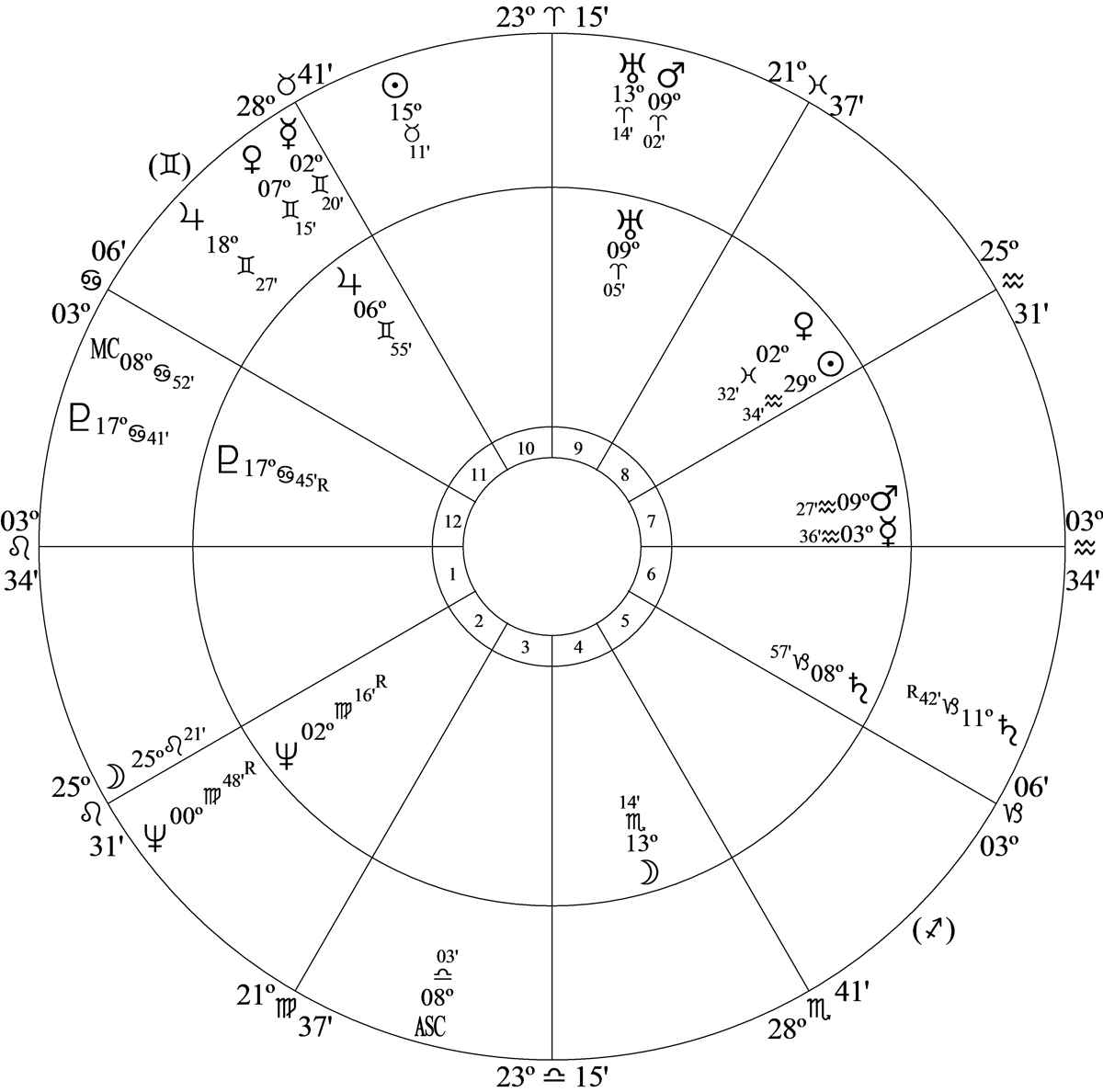
Chart data is 4.00pm MST, February 18, 1930: 35N12; 111W39 (Flagstaff, Arizona)
Event markers are a progressed aspect to the ruler of house 1 or ascendant, house 10 or Midheaven (publicity) and house 12 (sorrow and disappointment; and Mercury (science and criticism), Mars (outrage), Saturn (loss), Uranus (radical change) and Pluto (groups) with discord predominant.
Progressed Sun at 16N24 – the cusp ruler of house 1 in house 10 – was parallel birth chart Moon at 16N30 – the cusp ruler of house 12 in house 4.
Progressed ascendant at 8 Libra 03 in house 3 was square birth chart Saturn at 8 Capricorn 57 in house 6.
Progressed Mars at 9 Aries 02 in house 9 was conjunction birth chart Uranus at 9 Aries 05 and square birth chart Saturn.
Progressed Midheaven at 8 Cancer 52 in house 12 was square progressed Mars and birth chart Uranus in house 9 and opposition birth chart Saturn in house 6.
And progressed Mercury at 2 Gemini 20 in house 11 was square birth chart Neptune at 2 Virgo 16 R in house 2 and semisquare birth chart and progressed Pluto at 17 Caner 45R and 17 Cancer 41 in house 12.
On December 7, 2010 Mike Brown’s memoir ‘How I Killed Pluto and Why it Had it Coming’ was published. The title bears a Lower-Pluto sentiment.
Pluto’s demotion to dwarf planet was a judgement made by astronomers expressing very limited intelligence and it didn’t stop Pluto being the ninth planet, and it didn’t stop Pluto transmitting its astrological vibration. Astronomers are totally ignorant of God’s living universe and natural law.
The dwarf planets Ceres, Eris, Haumea and Makemake do not transmit astrological radiations and have no influence on life.
A Pluto factcheck
A Pluto person, consciously or unconsciously, easily tunes in on the thoughts and energies being broadcast from the inner-planes. This gives them access to unusual sources of information and power. They are active, energetic and resourceful, and tend to unite with others to accomplish a common purpose.
They are never milk and water in what they do, and if occasion demands don’t hesitate to resort to violence. When the destructive side is dominant, all their resourcefulness and energy are turned against society. They then become the gangster and racketeer who unites with others of their type to spread subtle lies and prey upon humanity.
Their best quality is spirituality and their worst is inversion.
The suppression of facts and the distortion of information to create a public opinion favorable to some group, or favorable to the purpose of some group, is the greatest menace they afford, and is perhaps the greatest menace to human progress.
The best and worst side of Pluto are more vividly in contrast than those of any other planet. The thoughts ruled by it are called the universal welfare thoughts.
Astrology for Aquarius – sharing our knowledge