The Encyclopedia Britannica website will inform you that Stonehenge is a prehistoric stone circle monument, cemetery, and archaeological site located on Salisbury Plain, about 8 miles (13 km) north of Salisbury, Wiltshire in England.
It was built in six stages between 3000 and 1520 BCE, during the transition from the Neolithic Period (New Stone Age) to the Bronze Age. It’s presumed to be a religious site and is aligned on the Sun but its true meaning and purpose, which has long been subject to historical speculation, remains unknown.
English antiquarian John Aubrey in the 17th century and his compatriot archaeologist William Stukeley in the 18th century both believed the structure to be a Druid temple, but this idea has been rejected by more-recent scholars as Stonehenge is now understood to have predated by some 2,000 years the Druids recorded by Julius Caesar.
In 1963 American astronomer Gerald Hawkins proposed that Stonehenge had been constructed as a ‘computer’ to predict lunar and solar eclipses but this too has been rejected by experts.
In 1973 English archaeologist Colin Renfrew hypothesized that Stonehenge was the centre of a confederation of Bronze Age chiefdoms; in 1998 Malagasy archaeologist Ramilisonina proposed that Stonehenge was built as a monument to the ancestral dead, the permanence of its stones representing the eternal afterlife; and in 2008 British archaeologists Tim Darvill and Geoffrey Wainwright suggested that Stonehenge was used in prehistory as a place of healing.
It’s doubtful if it was used by the Druids (Celtic priests), but present-day Druids gather there every year to hail the midsummer sunrise. Looking toward the sunrise, the entrance in the northeast points over a big pillar, now leaning at an angle, called the Heel Stone. Looking the other way, it points to the midwinter sunset. The summer solstice is also celebrated there by huge crowds of visitors.
Stonehenge was designated a UNESCO World Heritage site in 1986.
Stonehenge: The heavens in stone
In 1933 The National Astrological Journal was first published in America and in the August 1933 edition it presented Elbert Benjamine’s article ‘The Heavens in Stone: Midsummer Sunrise and the Forgotten Rights of Stonehenge’. Here’s what Elbert wrote:
In the County of Wiltshire, England, you can still see the ruins of what is probably the most perfect example of its kind of an ancient temple of the Religion of the Stars.
Stonehenge has been reconstructed as a model; and archaeologists are able to provide a detailed description of its original appearance and structure. Their opinion is that it was built about four thousand years ago.
The history of the region goes back about half that far – only to the time of the Roman conquest. At this much later date, Roman history records that the Druid priests taught many things about the size and dimensions of the heavens and the various motions of the stars. They believed the soul of a human being had previously occupied lower forms of life; and that after death people live, much as they live on Earth, in some superior region.
With this account of the beliefs of those still inhabiting the vicinity at the time of the Roman invasion, let us read Stonehenge in terms of its own language, the language of universal symbolism.
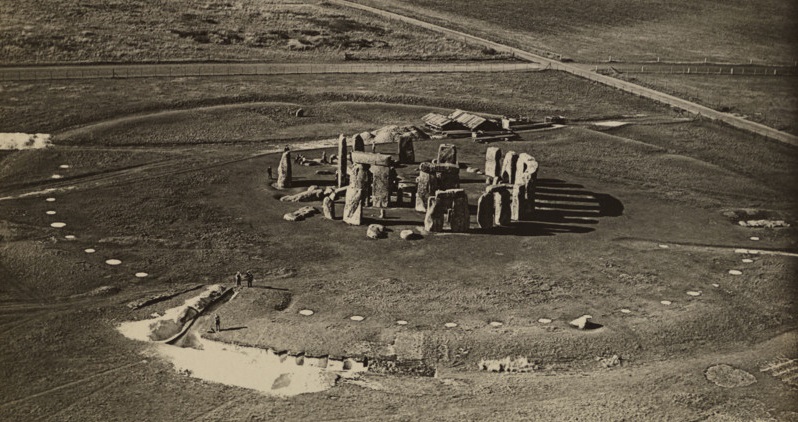
The long avenue of stones leading from the northeast indicates the path of evolution leading through lower forms of life up to the state of human birth.
The direction of approach is from the northeast, because it is from the northeast that the soul is born: that is, the house of birth – the first house of a birth chart – is in the northeast part of the map.
The outside of this temple (Stonehenge) consists of a circular earthwork three hundred feet in diameter. Because the constellations surrounding the zodiac, and picturing its influence, are composed of an infinite number of stars, such a mound, not distinguished by well-marked divisions, well represents the surrounding starry firmaments.
Immediately within this earthwork originally was a circle of small ‘foreign stones’ the foundations of which only now remain. These ‘foreign stones’ represent the influence of the zodiac and its divisions.
Then, interior to these, comes a complete ring of hewn stones with lintels mortised to their tops, making a series of doorways. These doorways, extending completely around the circle, are not made of ‘foreign stones,’ because the houses of a birth chart are not dependent upon stellar influences, but upon the position on the Earth where such influences fall.
Inside this ring of stone doorways is another ring of ‘foreign stones,’ indicating the motion of the planets in their orbits.
Within these is a horseshoe of five dolmens. The number five is the symbol of man, and was so considered in all the ancient schools. A dolmen, consisting of two upright stones with a horizontal stone on top, is a doorway; the horizontal stone conveys the idea of a higher plane. The five dolmens signify the belief that people pass through the doorway of physical dissolution to continue life and effort in a higher realm.
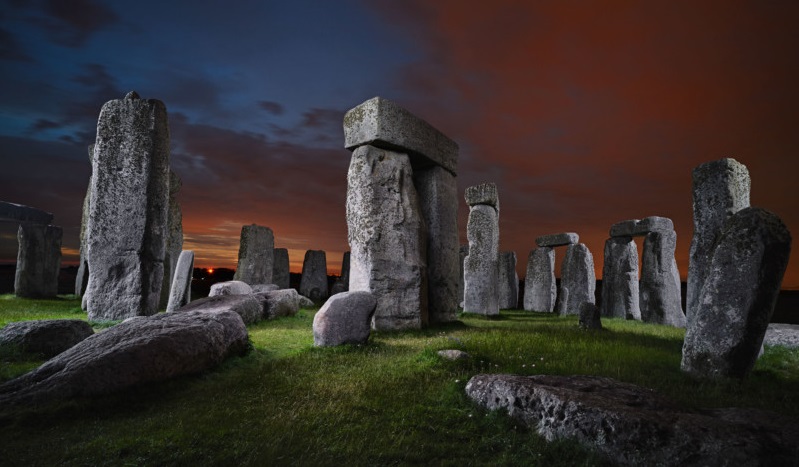
Within the five dolmens is a horseshoe of ‘foreign stones.’
The horseshoe form is the symbol of the feminine in nature, even as the single upright stone is the symbol of the masculine. The crescent is also the symbol of the Moon. Within the curve of this horseshoe is a flat, horizontal slab of stone serving as an altar.
In this temple many different ceremonies were performed, but I’ll mention only one. The neophyte to be initiated, standing on this slab of stone within the horseshoe at sunrise on the day of the summer solstice, portrayed the age-old mystery of the immaculate conception.
In the center of the avenue of approach, and so located that the rising Sun on the longest day of the year sheds its rays directly over it into the horseshoe and upon the altar, is a large, unworked, upright stone, representing the Sun and the masculine in nature.
In nature there is a constructive principle and a destructive principle.
Light is the universal symbol of the constructive attribute, while darkness is representative of that which is destructive.
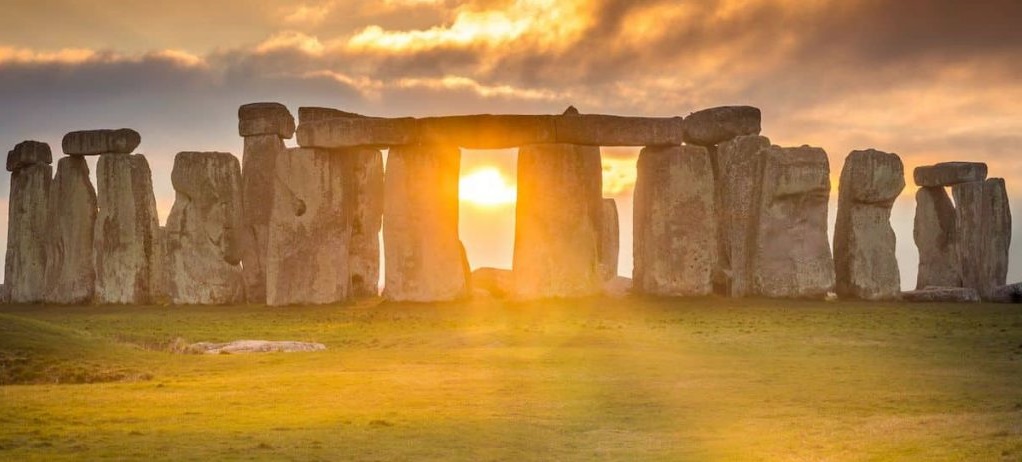
At the time of the summer solstice the day is longest, the Sun highest in the heavens. Symbolically, the power of light then reaches its maximum. The neophyte (aka novice or learner), standing on the altar as the rising Sun that day sheds its light over the Sun stone, represents the soul within the womb of matter, reunited to its divine source by a spiritual ray.
The avenue and its stones indicate the steps the neophyte has taken to reach their present state of illumination. Their position reveals that they know that physical life is merely a period of gestation, from which they will be born into a more glorious life and existence.
They are surrounded by symbols that represent the mundane houses, the zodiac and the planets, indicating that they recognize their influence both upon their life here and upon their life on the higher plane, signified by the dolmens.
The ‘foreign stones’ which represent the influence of the zodiac, the circling planets and the crescent Moon, have not been quarried, like the other stones, in the near vicinity; but to represent their influence as coming from afar, have been brought from some distant place.
The neophyte, with the light of the rising Sun – on this longest day of the year – shining upon them has come into a realization of the meaning of life; that life below is a preparatory school in which the soul is trained according to the function it is to perform in the universal organization.
They are fully aware that their soul entered matter to gain this training, and now, as indicated by the rays of the rising Sun reaching them, it is once more consciously united to its ego, to the sun of its divine source.
Now and hereafter, astrological forces will play their part; but having arrived at the state of true illumination, they are no longer a neophyte, for they are conscious of their cosmic work.
Astrology for Aquarius – sharing our knowledge